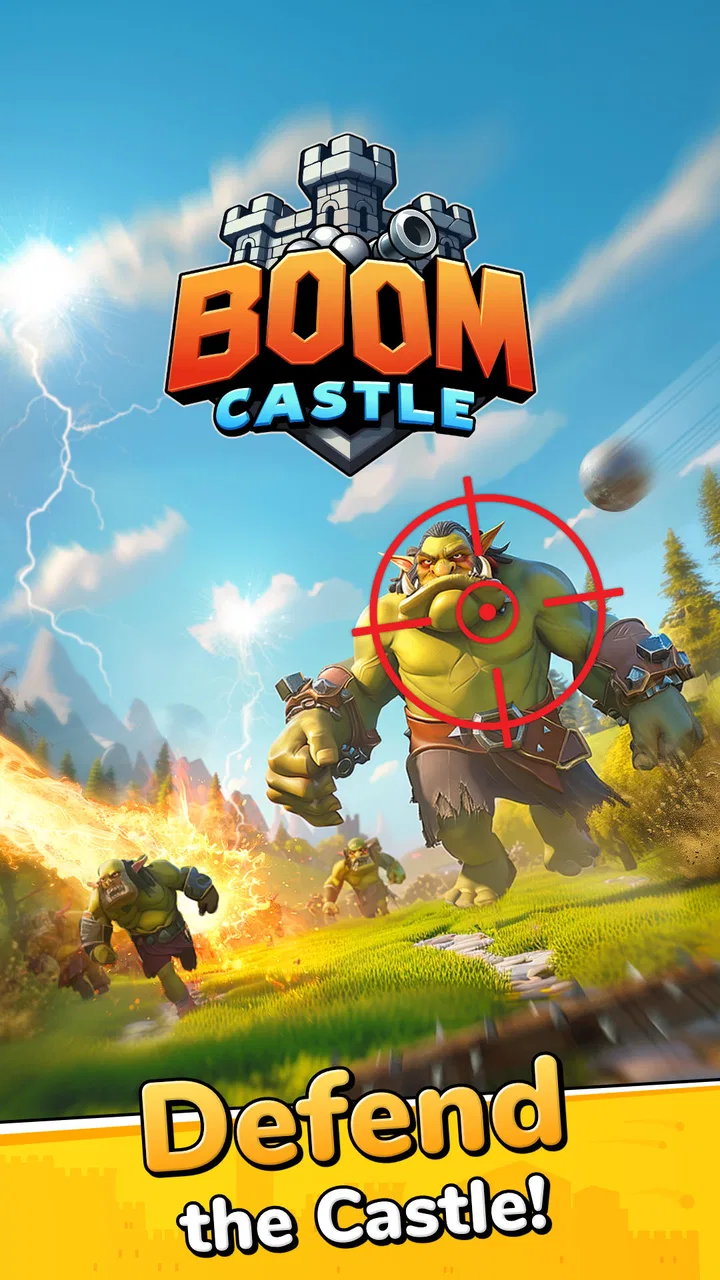
Boom Castle: Tower Defense TD
- 4.3
- Rating
- 1.00M
- Installs
- Free
- Price

 Analysis by App-foxy
I went into Boom Castle: Tower Defense TD expecting a quick, low-pressure mobile game, and that is largely what I found. It is a casual idle tower defense game built around improving heroes, watching them handle incoming enemies, collecting the results, and deciding how far to push the next attempt. The appeal is not a complicated story or a huge control scheme. It is the small, repeatable satisfaction of making a stronger team, surviving a little longer, and starting again with a better plan.
That loop makes it easy to play in short breaks, but it also creates the main question: do you enjoy gradual progress when the game does much of the fighting for you? In my experience, the answer depends on whether you want a hands-on strategy game or something lighter that keeps moving while you make occasional decisions. Boom Castle fits the second group much better.
How the first action feels
The first meaningful action is simple: improve the heroes protecting the castle and send them into another wave-based challenge. You are not constantly dragging units around or manually aiming every attack. Instead, the game puts the emphasis on choosing when to strengthen your side and then seeing whether those improvements are enough to deal with what arrives.
You May Also Like

 Blood Strike: 2.5 Anniversary
Blood Strike’s Loadouts Turn Every Drop Into a Tactical Gamble
A close look at Blood Strike’s custom loadouts: how fast access to signature weapons reshapes its battle royale rhythm, rewards preparation, and narrows the gap between fights.

 Pandora - Music & Podcasts
Pandora’s Music Is Easy to Start, but Harder to Recover
Pandora’s strength is its low-effort path from a seed to a station. Its weak spot is how much confidence it asks you to place in connection, setup, and quiet recovery.

 8 Ball Pool
 Is Built on Rivalries, Rematches, and Routine
A close look at the rivalries, rematches, shared routines, and unanswered safety questions that turn a quick pool match into a persistent mobile community.

 Samsung Music
’s Quiet Strength Is Playing What You Already Own
Its reach comes less from spectacle than from dependable access to a personal library. That simplicity is both the app’s strongest retention engine and its ceiling.

 AccuWeather: Weather Radar
AccuWeather Review: A Quick, Clear Forecast for Everyday Decisions
For everyday plans, the best forecast is the one you can understand quickly. AccuWeather makes rain timing, radar, and local conditions easy to act on, with a few trade-offs.

 Hill Climb Racing
Why Hill Climb Racing Still Turns Crashes Into One More Run
A tiny car, a bumpy hill and one more upgrade: Hill Climb Racing keeps resurfacing because its simple chaos makes every near-miss feel personal.
More From Our News Desk



That makes the opening minutes approachable. I did not need to learn a long list of commands before understanding the basic purpose of each session. The castle is the focal point, enemies advance in waves, and the heroes provide the force needed to keep the defense going. The straightforward setup is a good match for the game’s casual identity, especially if you want something that can be understood quickly rather than studied like a traditional strategy title.
The trade-off is that players who enjoy direct control may feel slightly removed from the action. Your choices matter, but they are usually preparation choices rather than moment-to-moment commands. If you prefer placing towers with precision, adjusting firing priorities, or reacting manually to every enemy, a more traditional tower defense game will probably give you a deeper sense of control.
For me, the hands-off structure worked best when I treated each attempt as a small experiment. I would upgrade a hero, watch the next group of enemies, and pay attention to whether the extra strength actually changed the result. That is more useful than upgrading automatically after every reward. The game becomes more interesting when you connect an improvement to a specific problem, such as failing soon after a new wave begins.
A practical routine is to avoid spending everything immediately. Keep enough room to compare the effect of one improvement before committing to another. This is one of the less obvious ways to get more value from an idle defense game: the reward screen is not only a place to collect currency, but also a checkpoint for deciding what caused the previous attempt to fail.
What you are really controlling
Although the heroes do the fighting, the player controls the pace of development. That distinction is important. Boom Castle is not asking you to win through quick reflexes. It asks you to recognize when the current defense has reached its limit and use the next reward to move that limit forward.
I found this especially suitable for short sessions during an ordinary day. If I had a few minutes between tasks, I could check the current run, make an upgrade decision, and leave without needing to remember a complicated position on a map. Later, returning to the same defense felt natural because the goal remained clear: improve the team and test it against another sequence of enemies.
The game is free to play, which lowers the barrier to trying it. It is rated for Everyone 10+, and that broad age positioning matches the accessible presentation and uncomplicated premise. Still, free access does not automatically mean the progression will suit everyone. Players who dislike waiting for upgrades, repeated attempts, or optional spending should approach it with realistic expectations.
The feedback rhythm: attack, pressure, and response
The strongest part of the experience is the feedback rhythm. A wave arrives, your heroes attack, the defense either holds or begins to struggle, and the outcome tells you whether your previous decision was useful. That sequence gives the game its momentum. Even when I was not actively tapping during the fighting, I was still watching for signs that the next improvement had made a real difference.
Good idle games make progress visible enough that the player understands why another session is worthwhile. Boom Castle does this through the contrast between a previous attempt and a stronger one. When an upgrade lets the castle survive a little longer or handle a difficult section more comfortably, the reward feels connected to the action rather than completely random.
There is also a quiet tension in letting a run continue. You may be close to the point where the current team can no longer cope, but another wave might still produce enough progress to justify waiting. That uncertainty gives the otherwise relaxed structure a reason to keep watching. The game does not need frantic controls to create pressure; the question of whether your current strength is sufficient does much of the work.
My advice is to watch the transition between comfortable waves and difficult ones instead of focusing only on the final defeat. The first moment when enemies begin taking longer to clear is often more informative than the final failure. It shows where your damage or survivability is falling behind, giving you a clearer upgrade target for the next round.
This is also where the game differs from many conventional tower defense alternatives. In a classic title, the feedback is immediate and positional: a tower covers a lane, an enemy slips through, and you correct the layout. Here, feedback is more developmental. You improve the heroes, repeat the defense, and judge the result over a longer progression curve. That makes Boom Castle calmer, but also less tactically rich on individual maps.
Why the wave structure keeps the loop moving
Waves provide natural stopping points without making every session feel like a formal level. I could let an attempt run, check the outcome, and decide whether to continue investing or reset my expectations. This structure works well on a phone because it does not demand a long uninterrupted block of attention.
The weakness is repetition. If you need a constant stream of new mechanics, the cycle of strengthening heroes and facing more enemies may begin to feel familiar. The game’s enjoyment depends on whether the gradual change in power is satisfying enough to compensate for the repeated shape of each attempt.
I would not recommend treating every wave as something you must actively supervise. The better approach is to use the game as a check-in experience. Start a defense, make a deliberate improvement, and return when you want to see the result. That keeps the idle element useful instead of turning the game into a task that needs constant monitoring.
Rewards that make another attempt worthwhile
The reward stage is where the game turns survival into motivation. After dealing with enemies, you have a reason to improve the heroes and try again. The important question is not simply how much you receive, but whether the reward changes what you can do next. A useful reward should make the next run feel meaningfully different, even if the difference is gradual.
In my experience, the best spending decision is the one that addresses the exact point where the defense became uncomfortable. If enemies overwhelm the castle quickly, a general increase in strength may be more useful than spreading resources across every available option. If the defense is almost stable but begins to slow down, improving offensive capability may produce a more noticeable result. The game is more satisfying when rewards are used with a purpose rather than collected and spent automatically.
This creates a small but worthwhile planning layer. You are not building a complex spreadsheet, yet you are still asking whether the next upgrade should make the heroes hit harder, help the defense last longer, or simply push the overall team toward the next threshold. That decision is the main strategic texture of the experience.
One useful habit is to keep a mental note of the last successful wave before spending. After an upgrade, compare the new run against that point rather than expecting a dramatic transformation. Idle progression often works through several modest improvements, and judging each purchase by whether it moves the boundary forward helps prevent disappointment.
The game includes in-app purchases ranging from less than a dollar to amounts approaching a hundred dollars per item. That range is important for anyone who wants to play without spending. I would begin with the free experience and decide whether the normal reward loop feels satisfying before considering any purchase. If the basic cycle already feels too repetitive, paying will not solve the underlying issue of wanting more direct variety.
For players who enjoy supporting a game or accelerating progress, optional purchases may be convenient. However, I would treat them as a personal shortcut rather than a requirement for understanding the game. The central enjoyment should come from seeing your defense improve through repeated decisions, not from feeling pressured to buy your way past every difficult wave.
A realistic everyday session
Imagine checking Boom Castle during a short lunch break. You open the game, see how far the current defense has progressed, collect what the attempt has earned, and inspect the heroes before choosing one improvement. You then begin another run and watch long enough to see whether the opening waves feel easier. If they do, you can close the game and return later; if they do not, you have learned that the chosen upgrade did not address the immediate problem.
That is the kind of use case where the game makes sense. It does not demand that you reserve an entire evening or memorize a complicated strategy. The session has a clear action, a visible response, a reward, and a reason to return. It also ends naturally when you decide that the next improvement requires more progress.
On the other hand, someone looking for a fully active game during that same break may be disappointed. The central entertainment comes from managing progression around the combat rather than controlling every attack. For that player, a manually played tower defense game would probably offer more satisfying involvement.
The reset: why failure does not end the experience
Every idle progression game needs a convincing reason to begin again after a run stops. In Boom Castle, the reset is not really a punishment; it is a measurement. The failed or completed attempt shows the current limit of your heroes, while the next round gives you a chance to test the improvement you earned.
I like this structure when the reset feels informative. A run that ends at roughly the same point as the previous one can still be useful if it reveals that the latest upgrade was too small or aimed at the wrong weakness. The important thing is to treat the restart as feedback, not as lost time.
There is a potential frustration here for players who expect every session to unlock something dramatic. Progress can feel slow when several attempts are needed before the defense clearly moves forward. That is normal for the idle format, but it means patience is part of the game’s design. If repeated runs without immediate breakthroughs irritate you, this may not be the right casual game for your taste.
I found resets easier to accept when I set a small goal for each attempt. Instead of demanding a major leap, I would aim to make the opening section more comfortable, reach a slightly tougher point, or confirm that a particular hero improvement was useful. Small goals make the reset feel like part of a testing process rather than a loop that is merely repeating itself.
The reset also helps define who should skip the game. I would not choose Boom Castle for competitive players who want precise timing, complex map layouts, or a large number of active tactical decisions. I would also skip it if I wanted a story-driven adventure with constant new scenes. Its strengths are narrower: accessible defense, gradual hero improvement, and a low-pressure reason to return.
How it compares with other casual defenses
Compared with a standard tower defense game, Boom Castle places less emphasis on arranging a perfect defense in the moment. That makes it easier to pick up and better suited to fragmented play, but it reduces the satisfaction of solving a map through placement and timing. A traditional alternative is better when you want every enemy path and tower position to matter.
Compared with a purely passive idle game, Boom Castle gives the progress a more recognizable purpose. You are not simply watching a number rise; the upgrades are tied to heroes, a castle, and enemy waves. That framing gives the waiting and returning cycle more shape. Still, it remains less active than games built around continuous tapping, aiming, or direct combat.
Its middle position is both its identity and its limitation. The game is more structured than a bare progress simulator, yet less demanding than a full strategy defense title. I would recommend it to someone who wants the comfort of an idle game but still enjoys making upgrade choices connected to visible battles.
Who will enjoy it and how to get the most from it
Boom Castle is a good fit for players who like gradual improvement, short check-ins, and simple decisions with visible consequences. It also suits people who want a casual game that can be understood quickly without committing to a long tutorial or an elaborate control system. The free entry makes it easy to test whether the rhythm feels right before spending anything.
It is less suitable for anyone who needs constant novelty or direct control. If your favorite part of tower defense is physically placing defenses under pressure, the idle structure may feel too distant. If you dislike repeating a run after reaching a limit, the reset cycle may become tiring rather than motivating.
To play more thoughtfully, I would use three habits. First, observe where the defense begins to slow instead of waiting only for the final defeat. Second, make one meaningful upgrade at a time when possible, so you can connect the result to the decision. Third, treat each return as a short test rather than an obligation to stay until the run ends.
Those habits bring out the game’s strongest quality: the loop is easy to understand, but it rewards a little attention. You can play casually, yet still make better choices by noticing the difference between a run that is genuinely stronger and one that merely lasts a little longer by chance.
My verdict on the complete loop
At the time of my review, the game is on version 1.9.7 and has built a sizable audience, with an average rating of 4.3 from around 142 thousand ratings and more than a million installs. Those figures suggest that the compact idle-defense format has found plenty of players, and I can see why: the action is understandable, the feedback arrives in waves, and every reward points toward another attempt.
TERAHYPE - AR, GPS & Fantasy RPG + Casual Games has kept the concept focused on a simple question: can the upgraded heroes survive farther than before? That focus works because the game does not pretend to be a fully active tower defense experience. It offers a lighter alternative for people who enjoy watching a defense develop and making occasional choices around it.
My honest recommendation is to try it if you want a casual castle defense game for short, repeatable sessions. Start without spending, pay attention to where each run weakens, and use rewards to solve that specific problem. If the action feels too passive after a few attempts, move to a more hands-on tower defense game rather than forcing yourself through a loop that does not match your preferences.
For the right player, the reset is the reward: you survive, learn the limit, strengthen the heroes, and begin again with a believable reason to expect a better result. That simple action-feedback-reward cycle is Boom Castle’s real strength, and it is enough to make the game an enjoyable casual companion, even if it will not satisfy players looking for deep real-time strategy.
FAQs for Boom Castle: Tower Defense TD
01What is Boom Castle: Tower Defense TD?
Boom Castle: Tower Defense TD is a strategy game centered on defending your castle against waves of incoming enemies. You place and upgrade defensive units, manage the battlefield, and try to stop opponents before they reach your stronghold. Its gameplay combines tower-defense planning with progression elements, making it suitable for players who enjoy short tactical battles and gradually improving their defenses.
02How does the gameplay work in Boom Castle: Tower Defense TD?
The main objective is to survive enemy attacks by choosing suitable defenses and positioning them effectively. Different enemies may require different strategies, so simply building the strongest available unit is not always enough. During a level, players generally need to monitor the battlefield, spend resources carefully, upgrade useful towers, and adapt their setup as enemy waves become more difficult.
03Is Boom Castle: Tower Defense TD free to download and play?
Boom Castle: Tower Defense TD can generally be downloaded without an upfront purchase, although the exact availability and monetization options may depend on the Android or iOS version. Like many free tower-defense games, it may include optional in-app purchases, advertisements, or time-saving features. Before downloading, check the store listing for current pricing, supported devices, and any purchase-related information.
04Does Boom Castle: Tower Defense TD require an internet connection?
The need for an internet connection can vary depending on the version and the feature being used. Basic tower-defense stages may work offline, but advertisements, cloud saving, updates, account services, or other online functions may require connectivity. If playing while traveling or with limited data, it is best to test the game after installation and confirm which features remain available without an active connection.
05Is Boom Castle: Tower Defense TD suitable for beginners?
The game is approachable for newcomers because tower-defense controls and objectives are usually easy to understand, but later stages can demand more careful planning. Beginners should take time to learn enemy patterns, understand each defensive unit, and avoid spending resources too quickly. Players who enjoy experimenting with layouts and replaying levels to improve their results will likely get the most from the experience.
Pros
- Quick matches make it easy to play in short sessions.
- Tower upgrades offer satisfying progression and strategic choices.
- Colorful visuals and clear effects make battles easy to follow.
- Different enemy types encourage players to adjust their defenses.
- Offline play may be convenient when an internet connection is unavailable.
Cons
- Later stages can become noticeably grindy without frequent upgrades.
- Some upgrades or rewards may encourage repeated gameplay.
- Limited tower variety can reduce strategic depth over time.
- Difficulty spikes may make certain levels feel unfair without retries.
- The small screen can make precise tower placement uncomfortable on phones.

Boom Castle: Tower Defense TD
Gallery